by Daniella Richardson | Dec 2, 2020 | Newsroom
The ongoing issues with insureds’ contract requirements force insurance professionals to push the envelope each and every day. Trying to keep up with a client’s needs can take a great deal of effort, and with pollution coverage becoming a very real issue for most business owners and operators, it is important to understand the differences in coverage forms. One major point to focus on is the important difference between Sudden & Accidental and Broad Form Contractors Pollution Liability.
Over the past twenty years, the insurance industry has provided Sudden & Accidental Pollution coverage to a variety of business classes. This coverage was meant to satisfy policy holders and property owners that were concerned with the potential for a pollution loss. Sudden & Accidental coverage is tied to a discovery and reporting period, and generally covers bodily injury and property damage caused by a pollution loss. The main issue with this fact is that if the loss happens over time or is not discovered or reported in the time allowed under the policy form, there is no coverage in place. Also, these forms tend to not have completed operations, action over, or clean-up costs included.
Over the last decade, we have all seen companies that have started to provide broad form Contractors Pollution Liability coverage to many of these same industries. The Contractors Pollution Liability form covers bodily injury, property damage, and clean up expenses. Most of these forms also include completed operations and action over coverage, allowing for a much broader policy and giving real coverage to the insureds and their certificate holders. These policies are written on a claims-made basis and the discovery and reporting period are tied to the policy term.
With the environmental departments continually growing and issues like the BP offshore incident, your insureds have a greater need to protect themselves from Pollution exposures and threats. Property owners, contract holders, and certificate requests are going to continue to ask for Pollution coverage and higher limits with broader terms. This is going to put more pressure on insurance brokers to provide for these needs and to make sure the gaps in their clients’ insurance programs are covered. This can be done with a simple standalone Contractors Pollution Liability policy that can also include Products Pollution Liability, Transportation Pollution Liability, and some Site Specific coverage.
Always remember that when your insured is on a third party’s site, they are exposed to environmental risk they may not generate. We cannot anticipate who an insured will work for or what conditions they may be dealing with in their daily operations. Accidents can happen, and with one simple insurance policy, you can remove the worry over the total or absolute pollution exclusion on the General Liability policy. We have to remember that thinking outside the box and providing expertise are the main reasons the insured pays his or her insurance agent. In order to protect both the client and the brokers organization, it is crucial to be educated on environmental exposures and the forms that address them.

by Daniella Richardson | Nov 16, 2020 | Newsroom
Sudden & Accidental coverage is tied to a discovery and reporting period, and generally covers bodily injury and property damage caused by a pollution loss. If a claim comes in and is a gradual loss or is not discovered and reported in the time allowed under the policy form, there is no coverage in place.
Through the years, the term “Sudden & Accidental” pollution has been litigated vigorously and there has been much debate about the meaning of Sudden and Accidental versus a Non-Sudden and Gradual (gradual) pollution event. A classic example of the complexity of this issue involves the circumstance where an area of a site has staining, and the cause of the staining has been determined to be a leak from a pipe. A question is posed as to whether the staining was caused by a sudden and accidental event or a gradual event. If one believes that it is a result of a sudden and accidental event – is it because the event was the first drop (and everything subsequent to that was the same occurrence)?
Conversely, was the staining the result of a non-sudden & gradual, consistent stream of drops over time? Even if it was determined that the stain was a result of a gradual release, shouldn’t the first drop be considered an sudden and accidental event and therefore, some amount of the staining would fall into the sudden and accidental category? There are many opinions that one might have with regard to this simple example and this is only a glimpse of how complicated this debate became.
What is the difference between Sudden & Accidental Coverage vs. Non-Sudden and Gradual Coverage?
The word “sudden” had been litigated extensively in many courts, and was initially interpreted to mean “unexpected”, rather than “quick”. The word “accidental” was often interpreted as “unintended”. This broad interpretation of sudden and accidental, i.e., “unexpected and unintended”, rather than “quick”, resulted in many court decisions that were advantageous to the insured because of the fact that the unclear interpretation of the words resulted in ambiguities.
Over time, this broad, ambiguous interpretation of sudden and accidental became narrower. In recent years, sudden and accidental has been interpreted to mean that it takes place in its entirety at a specific time and place. Insureds may have difficulty demonstrating that a pollution condition or release of pollutants was sudden and took place at a specific time.
Many, but not all, environmental insurance policies provide coverage for both sudden and accidental and gradual pollution releases. There is no distinction between one or the other in most environmental insurance forms. With gradual coverage in place, the insured does not have to be concerned about meeting the reporting requirements outlined in the time element trigger, or the potential ambiguity of older sudden and accidental forms.
Non-sudden and gradual coverage in premises specific forms is not without its issues as well. It is important for insureds to understand the difference between “unknown” pre-existing conditions and “new” conditions. Sudden & Accidental is typically a coverage enhancement on a Contractors Pollution Liability, Site specific Pollution Liability or a combined/Package Pollution Liability policy for a client that demonstrates the need for the covers due to the nature of their business which could create an Environmental risk due to their business activities.
by Daniella Richardson | Jun 3, 2020 | Newsroom
The Ombudsman for Short-term Insurance has released it’s 2019 Financial Report. We at Blue Anchor have read this report and feel it’s importance to the market, here is a snap shot of what they reported.
OSTI recovered R94.9 million for consumers in 2019. This was more then both 2017 and 2018 (each amounting to around R87m) but less then both 2015 and 2016 (around 100m each). OSTI received 10367 complaints in this period of which 9167 were closed.
Almost half the complaints closed to the Ombud during this period were Motor Vehicle related – of which 19 percent were resolved in favour of the policy holder. The second highest category was Homeowner’s (building) insurance closing 21 percent of complaints – of which 15 percent favoured the policy holder. House contents insurance complaints were relatively low at only around 6 percent.
OSTI is expecting a surge in complaints post COVID-19 pandemic, largely in relation to business disruption and travel.
Read more here.
by Daniella Richardson | Apr 2, 2020 | Newsroom
South African Legislation
The Transportation of Dangerous Goods Regulations as set out in the National Road Traffic Act 93 of 1996 are intended to promote the safe transportation of hazardous material through the effective management of systems and processes.
With tons of dangerous goods being transported throughout South Africa and across the African continent every year, it is important to ensure the safety of this travel. Dangerous Goods can include everything from explosives, flammables, and corrosive or toxic chemicals to spent reactor fuel, low-level radioactive wastes, and disease-causing biological agents. If not controlled properly, these hazardous substances could present a potential hazard to human health and safety as well as that of the surrounding environment.
The National Road Traffic Act was implemented in August 2000. This legislation included provisions for the road transport of Dangerous Goods as listed in SANS10228 and the relevant regulations were enforced from 3 August 2001. Since then, the legislation has been updated to reflect new changes in regulations.
Read more at the source: https://dgrcompliance.co.za/national-road-traffic-act-93-of-1996/
by Daniella Richardson | Apr 2, 2020 | Newsroom
South Africa is well known for a rich history in mining and the export of mineral resources.
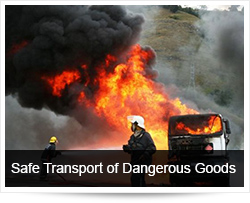
With the 10th largest road network in the world and a heavy reliance on road freight transport, it is to be expected that motorists often share the roads with the transporters of dangerous goods.
Are we aware of the risks presented by the transport of dangerous goods and what can we expect from the operators in this industry?
Do we know how to share the roads with dangerous goods vehicles and how to react when arriving at the scene of a road crash of a dangerous goods vehicle?
To answer these questions and to gain further insights into the transport of dangerous goods we approached some of the experts in the industry.
Read more at the source: https://www.arrivealive.mobi/safe-transport-of-dangerous-goods/